
Stanford GSB Expands AI Leadership in Silicon Valley
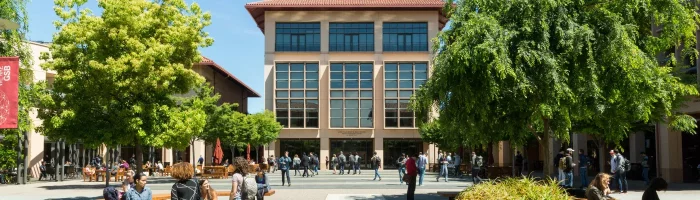
Situated at the heart of Silicon Valley, Stanford Graduate School of Business (Stanford GSB) is significantly expanding its artificial intelligence ecosystem across teaching, research, student initiatives, and executive education.
By embedding AI into every dimension of its academic environment, the school reinforces its role as a global leader in innovation-driven management education.
Reimagining Business Education in the Age of AI
Artificial intelligence is reshaping how organizations operate, compete, and create value. In response, Stanford GSB is redefining leadership education to equip students with the skills required to navigate this transformation.
Under the leadership of Dean Sarah A. Soule, the school is integrating AI literacy, strategic thinking, and applied machine learning into its core academic mission.
The objective is clear: prepare future leaders to understand not only how AI works, but how it fundamentally transforms industries and decision-making processes.
AI@GSB: A Student-Driven Innovation Platform
One of the most recent initiatives, AI@GSB, is a student-led platform designed to centralize and elevate AI-related learning opportunities across the school. The initiative connects students with industry practitioners through:
-
Applied workshops led by AI experts
-
A dean’s speaker series featuring technology leaders
-
Foundational AI primers to strengthen technical literacy
This hands-on approach ensures that students move beyond theory and actively engage with real-world AI applications.
AI Across the MBA and MSx Curriculum
Stanford GSB has rapidly increased the number of courses incorporating artificial intelligence and machine learning. In the 2025–26 academic year, nearly three dozen MBA and MSx courses integrate AI components.
Specialized courses explore AI’s role in strategy, accounting, entrepreneurship, and organizational transformation. Others examine broader societal implications, ethical considerations, and the future of work.
Experiential courses introduce AI-powered simulations, startup labs, and innovation sprints where students apply machine learning tools to live business challenges.
By combining technical depth with strategic insight, Stanford GSB ensures graduates are equipped to lead AI-enabled organizations.
Executive Education in the AI Era
Stanford GSB Executive Education has also expanded its AI-focused programming. Current offerings address digital transformation, innovation strategy, and AI-enabled organizational change. A new program dedicated to building AI-powered enterprises is scheduled to launch in 2026.
Through partnerships with Stanford’s d.school and technology collaborators, executive participants gain exposure to practical frameworks for integrating AI into corporate strategy.
A Thriving AI Student and Venture Ecosystem
AI plays a central role in student life and entrepreneurship at Stanford GSB. The Artificial Intelligence Club organizes panels, conferences, and industry discussions, fostering dialogue between students and global technology leaders.
Entrepreneurial initiatives such as Stanford Venture Studio regularly showcase AI-driven startup concepts, while innovation programs and summer accelerators increasingly feature ventures built around machine learning solutions.
The school’s Career Management Center is also leveraging AI tools to enhance job search strategies and identify emerging AI-related career pathways for students and alumni.
Research Excellence at the Frontiers of AI
Faculty research remains a cornerstone of Stanford GSB’s AI leadership. Scholars are advancing applied machine learning in healthcare, studying the intersection of AI and economics, and exploring the societal and organizational implications of algorithmic systems.
Research support infrastructure further strengthens this ecosystem. Faculty and students benefit from advanced computing resources, including high-performance GPU clusters, specialized research computing teams, and open-access AI experimentation platforms.
Centers such as the Golub Capital Social Impact Lab apply AI methodologies to address pressing global challenges, bridging academic rigor with societal impact.
Silicon Valley: A Strategic Advantage
Stanford GSB’s geographic position in Silicon Valley amplifies its AI commitment. Proximity to leading technology firms, venture capital networks, and innovation hubs enables close collaboration between academia and industry.
This environment fosters continuous exchange between researchers, entrepreneurs, and executives, ensuring that Stanford GSB remains at the forefront of AI-driven transformation.
Leading the Future of AI-Enabled Organizations
Through curriculum expansion, student-led initiatives, executive programs, and cutting-edge research, Stanford Graduate School of Business is embedding artificial intelligence into the core of business education.
By combining academic excellence, technological depth, and industry proximity, Stanford GSB prepares leaders to shape the next generation of AI-powered organizations.

Discover which business schools let you study in 3 different countries within a single degree. Compare ESCP, Skema, EM Normandie, and EDHEC on campus access, costs, and degree recognition.

Explore Bocconi's visionary 2026–2030 Strategic Plan, aimed at bolstering executive leadership, management training, and global expansion.

HEC Paris unveils “Dare the Impossible,” a new brand signature highlighting innovation, leadership, and its vision for education in a rapidly changing world.
